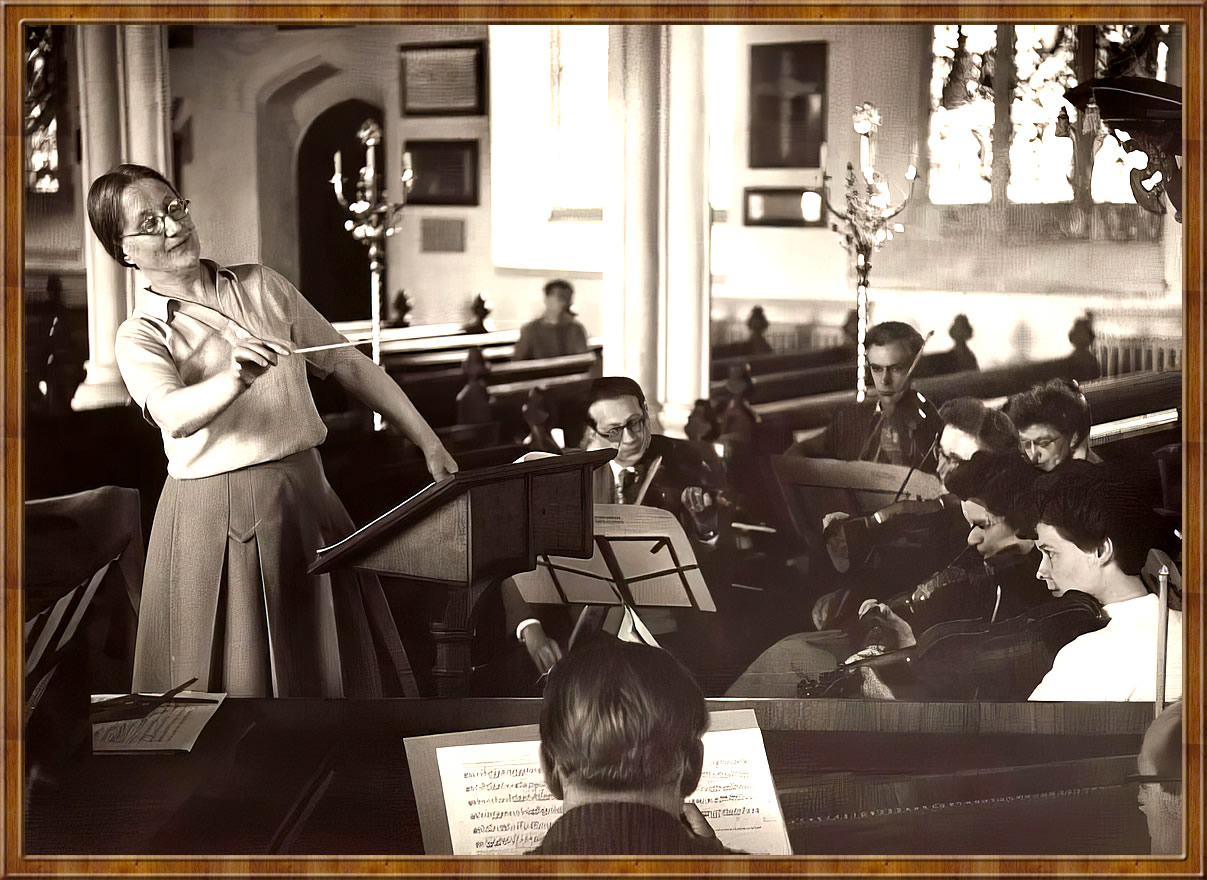
"Benjamin Britten and Woolverstone Hall"
from the autobiography of Merlin Channon supplied by Biddy, his daughter
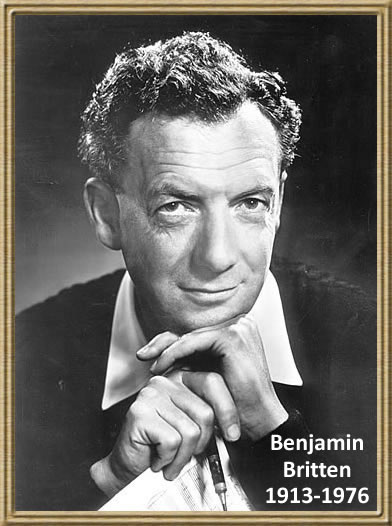
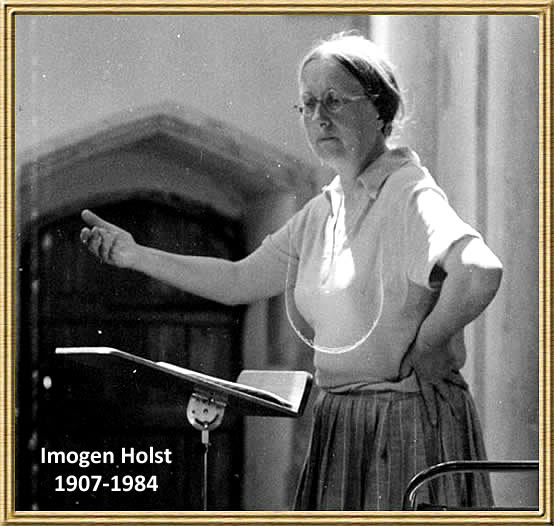
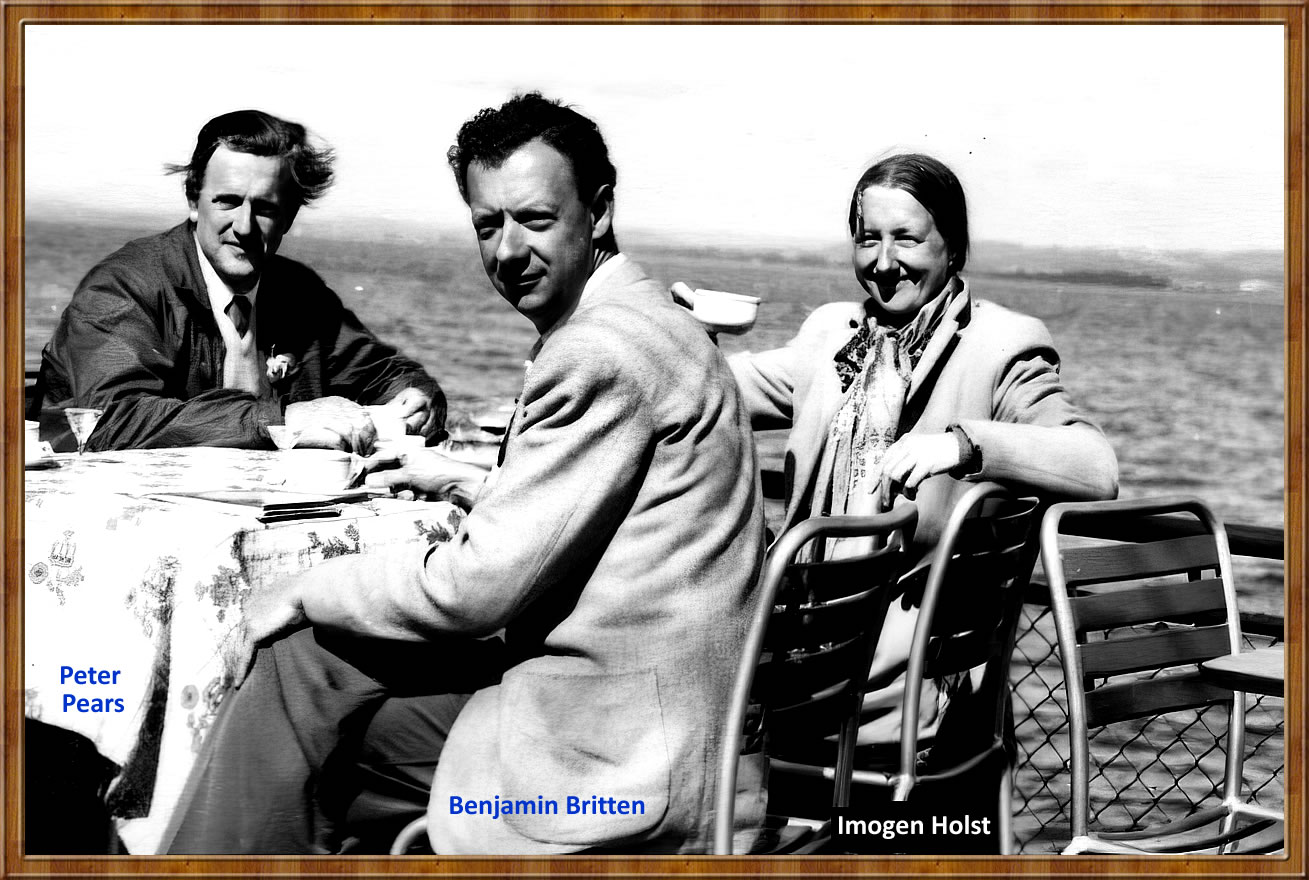
I imagine that few people living in Suffolk who were interested in music, either as players or listeners, were untouched by the Aldeburgh Festival at this time. In 1958 Benjamin Britten and Peter Pears were flourishing, and Imogen Holst had recently left Dartington Hall to become Britten's musical assistant. Together they formed a formidable team, with Britten very much in charge. Until Snape Maltings was converted into a concert hall in 1967, the Festival's performances were given in Aldeburgh Parish Church or in the Jubilee Hall: in the latter a number of Britten's operas were first performed. Outlying places such as the churches at Blythburgh, Framlingham and Orford were also used. Rehearsals often took place in local church halls or workman's clubs. My first experience of this remarkable festival came in 1958 through an invitation for the boys at Woolverstone Hall to provide percussion players for “Noye’s Fludde”, a setting of the Chester Miracle play which Britten had just written. We had been recommended to do this by Monica Cholmondley, director of the Suffolk Rural Music School, some of whose instrumental staff taught at Woolverstone Hall. For this work an enormous number of youngsters were required. Pupils of the SRMS provided a string orchestra, buglers came from the Royal Hospital School at Holbrook, handbell ringers were provided by a school in Leiston and recorder players from another in Framlingham. The large number of parts for animals were sung by pupils recruited from schools throughout Suffolk. Having accepted the invitation to provide the percussion players in this unknown piece, the composer arranged to come to Woolverstone to explain to us what was required. On a very special Spring afternoon a procession ascended the staircase overlooking the river Orwell, leading up to the Music Room. Benjamin Britten entered, armed with a large manuscript full score, a photographer, some very fine percussion instruments, a set of orchestral parts and a mysterious box. After the introductions the Headmaster, who had guided the procession to us, left me and the chosen seven boys to cope as best we could. Britten asked if he could tell us what the percussion parts involved, and he proceeded to undo the mysterious box of tricks. Then with obvious delight he began to tie a series of cups to a number of our music stands with some string he had brought along. The use of unusual sounds in his music was one of Britten's compositional interests. For “Noye's Fludde” he had decided that the raindrops falling on the ark before and after the storm could best be illustrated by players hitting tuned 'slung mugs' with a wooden spoon in unison with the piano. Later, on the advice of the celebrated percussionist, James Blades, the spoons were superseded by xylophone sticks. Those mugs had to form a scale and, in an article .'Working with Benjamin Britten' in The Musical Times in 1977, Imogen Holst revealed that this had caused Britten some difficulty. She explained: “He came round to see me saying he had tried it out at teatime and it wouldn't work. But by good fortune I had once had to teach Women's Institute percussion groups during a war-time 'social half-hour', so I was able to show him how a row of china mugs hanging on a length of string could be hit with a large wooden spoon.” Rumour had it that 'Imo', as she was affectionately known, went round Aldeburgh china shops hitting her way through the tea cups until she found those with the appropriate pitch. When she went to pay for them she was a little taken aback that she was charged for the saucers as well - so the story goes. Now, having set up those mugs in our music room and seen that the other instruments were ready, Britten handed out the percussion parts and proceeded to explain what he wanted. A brief rehearsal followed in which he made sure his percussionists knew what was required. He then suggested that we should try things out with the other parts played on the piano. Turning to me, and handing me a terrifying large manuscript full score, he asked if I would mind playing the other parts. I had no option but to agree. The first difficulty was to get this vast tome onto the music stand of our upright piano and keep it there. Britten began the rehearsal whilst I was left to hold the full score on the music stand with one hand and to gaze at it, wondering where to look. Quite alarmed and completely out of my depth I freely admit I made a terrible mess of things: so much so that at the end of the rehearsal Britten, said he wished he had taken a recording of my playing. Fortunately the young Woolverstone Hall percussionists all passed with flying colours. It was not long after our percussion team had passed their audition with aplomb that James Blades arrived at Woolverstone to coach them in the finer points of playing these instruments. Later still he gave one of his splendid illustrated talks on percussion instruments to the school. Next in the original 1958 “Noye 's Fludde” experience were the combined rehearsals of the Suffolk team of singers and players in such places as Thorpe Ness and Orford. Here we were joined by members of the English Chamber Orchestra, two professional pianists, a renowned organist, a solo recorder player, as well as James Blades. These combined rehearsals were taken by Charles Mackerras. Two amusing incidents have stayed with me all these years. The first occurred at an early combined rehearsal in Thorpe Ness. We had arrived in good time, but the music stands had not. So, rather than delay the rehearsal, Imogen Holst knelt before our slung muggist, as though a supplicant, holding up his music until the stands arrived and she could be released. Towards the end of the rehearsal I noticed that Yehudi Menuhin had looked in to see how things were going. Then, whilst a very young Suffolk violinist was packing his things away, Menuhin noticed him trying to get his instrument, as well as his bow, chin rest and music into his case. He smiled at the lad, but the latter was not convinced that the stranger's motives were of the highest. Gathering up all his equipment as quickly as he could, the lad rushed out of the hall and completed his packing well away from that strange man who appeared to have nefarious designs on his school violin. One of the extremely helpful devices that was issued to those of us responsible for training the “Noye's Fludde” young was a recording of the work. It seems that Britten, having just completed it, persuaded some of his friends to join him whilst he played a piano version of it. It was interesting to pick out the voices of Peter Pears singing the part of Noye, joined by Colin Graham, the producer, singing the parts allotted to several animals, whilst Imogen Holst gave a very plausible rendering of mice singing 'Kyrie, Kyrie, Kyrie'leison ' as the composer had written it — an octave higher and in double time to the rest of the animals. Britten himself sang a phrase or two: and that, I reckon, must have been the only time that he had appeared as a vocalist in any recording. There followed intense rehearsals at Orford church where Charles Mackerras put everything together. Then came the first performance, as part of the Aldeburgh Festival, conducted by the composer; this was followed by several others with Mackerras in charge. The effect of distinguished professionals and Suffolk youngsters, as well as the audience, participating in this remarkable piece was quite amazing. The Woolverstone team did so well that they received a special mention in the national press. But alas, one headline writer was widely inaccurate. 'Toddlers Play teacups' announced "The Daily Express" of Thursday, 18 June. "The Times" of 19 June had a spread of four photographs of the opera in progress, and in one of these some of the percussionists can be seen. In November, 1958 we were all taken up to Southwark Cathedral where “Noye's Fludde” had its first London performance: for this the composer himself conducted. Whilst “Noye's Fludde” was of immediate interest, the BBC decided to produce a programme on Benjamin Britten. John Schlesinger who was producing films for them at this time planned to introduce some work in it that had been done recently by Suffolk schools. For a week, with his crew, he toured the county collecting material. Then, by arrangement, one sunny Sunday afternoon they all arrived at Woolverstone looking exhausted: their last call before returning to London. I had arranged for the percussion players and their instruments to be on parade for whatever was required. The Schlesinger family were no strangers: Ann and I had met them at Music Camp. John was already a famous film director, so it was with some surprise that soon after our initial greetings he turned to me and asked what he should do. Somewhat taken aback, I suggested that he might like to film a percussion rehearsal that I could take. He thought my proposal was a good one and without further ado we got under way. All was going well until, in a fit of enthusiasm on the part of the player, first one slung mug crashed to the ground, followed by another soon afterwards. A new problem now arose. Where on earth on a Sunday evening in the country could tuned replacements be found? A surreptitious raid on the school kitchen provided the answer and, after a little experimenting, tuned replacements were found and appropriately slung. The rehearsal continued to everyone's satisfaction. Little did all those millions who saw the film on television know that under those replacements was boldly emblazoned the initials `LCC'. The film appeared on television for many years and I was always amused that people in the Midlands, when I was working there, frequently asked, 'Didn't I see you on the box last night? The usual reply to my admission was: "Well, the voice hasn't changed at any rate." Benjamin Britten was kindness itself to our percussion team: he bought one boy a splendid side drum and he even invited us all along to his home, The Red House, overlooking the golf course at Aldeburgh, where we had a good tea. At one stage during this feast, when he went off to fetch more cakes, it was interesting to spot his timetable for the day on his piano. Every single hour was carefully planned, and we noticed we had been allocated one of these: so we knew when to go. 1958 had been quite a year at Woolverstone Hall. On Whit Monday we had given two concerts to celebrate the opening of the new School Hall. At 4pm. we had performed most of J.S.Bach's “St John Passion” and then followed it with an orchestral concert at 6pm. That hall was to come in very handy for our future ventures. It seemed a pity not to follow up our connection with Benjamin Britten and so, having seen it at the Lyric Theatre in Hammersmith during our early married days, I suggested that we should undertake his “Let's Make an Opera”. By careful negotiation, we persuaded the Headmistress of the Ipswich High School for Girls to let some of her pupils join us. Audrey Hill, who was in charge of music at the school, I knew from the Ipswich Bach Choir, where she was the deputy conductor. She was an enormous help in coaching the girls. These, together with a number of musical friends, began to work at “Let's Make.” When we were getting near to the final rehearsal, we let Benjamin Britten know of our intentions. He showed great interest in what we were doing. He came to the final Sunday rehearsal and made some very useful suggestions to improve our production. Since we had no orchestral pit, he came up with the idea that we should reduce the orchestral sound by putting down carpets and draping a flag in front of the band over some hurdles. I thought his appearance at that rehearsal was all we could reasonably expect. But no, as he left he told us that he had accepted the Headmaster's invitation to come to the Gala Performance next Saturday evening, and coming he was. As though that was not enough, a telegram from him arrived on the morning of our first performance wishing us well and stating that he was looking forward to next Saturday. We were all flattered that he came to our Gala Performance on Saturday, 28 February, 1959. But for me it had its problems. “Let's Make an Opera “is in three Acts. The first is a play in which it is decided to devise an opera with the help of the audience. The second Act is largely concerned with the conductor rehearsing the audience in the music they have to sing, whilst the third is the performance of the opera. So there was I, in Act Two, teaching the audience how to sing the songs, whilst a member of that audience had actually written them. However, all went well and at the end of the opera the Headmaster persuaded the composer to say a few words. In a charming speech, Britten kindly referred to our production as fresh, and one that could well be envied by professionals. His reference to me as 'his friend, Merlin Channon' took me a long time to live down in the Masters' Common Room. It had all been a splendid example of help and co-operation by so many people. These included the Ipswich High School, James Blades who had lent us some of his percussion instruments, the English Opera Group who helped us out with costumes and properties, as well as the staff and boys who, under the guidance of the producer, Leslie Johnston, made it all possible. Opera had now made its mark on Woolverstone Hall. More Opera at Woolverstone Hall In 1960 I suggested that we should tackle Mozart's wonderful opera, “The Magic Flute”. As expected, this was a great joy to rehearse and our plans were well underway except for one major headache: who would sing the part of the Queen of Night? All the well-known soprano soloists in the locality refused to take this on. The 1960 Aldeburgh Festival For the opening of the Aldeburgh Festival in June, 1960, Benjamin Britten planned to give the first performance of his setting of “A Midsummer Night's Dream”. For this he needed a number of boy's voices to sing the part of Peaseblossom, Cobweb, Mustardseed, Moth and the Fairies. Michael Bauer's fame had reached the Aldeburgh set up and the distinguished musician, George Malcolm , came over to Woolverstone to audition him. As a result, Michael was chosen to be the first Peaseblossom. Even More Opera at Woolverstone Hall 1960 was quite an operatic year at Woolverstone. Overwhelmed by the success of “The Magic Flute” in the spring term we embarked on Weber's “Der Freischütz” in the autumn, and gave performances of it in December. Again we had the help of the Ipswich High School and a large cast took part in this exciting work. The chorus of bridesmaids, huntsmen, peasants and farmers numbered some sixty-five singers, whilst the production team consisted of twenty-eight of our community; with the orchestra, this was our largest operatic production so far. The 1961 Aldeburgh Festival In 1961 there came another surprise. Argo wished to record “Noye's Fludde”. Of course Woolverstone was invited to provide the percussionists, and other schools were to fill the same roles they had performed in 1958. The production was planned to be part of that year's Aldeburgh Festival. The invitation came, but little else occurred for a mighty long time. Britten was involved in writing other works, including his “War Requiem”; so there was a distinct absence of arrangements forthcoming for the 1961 “Noye's Fludde” production. Then another telephone call came from Stephen Reiss to ask if I would go to the Red House for a meeting with Benjamin Britten and then stay on for dinner. This turned out to be a combined business and social occasion with Britten carving and serving the meal, as well as surreptitiously feeding his small dog under the table, much to the annoyance of Imogen Holst. Clearly they wanted to make sure that I would go round the schools, not only to take some preliminary rehearsals, but also to placate the inhabitants: mine was to be largely an ambassadorial role on behalf of the Festival. And this I did until the appearance of Norman Del Mar. Norman arrived some ten days or so before the first performance at Orford in 1961. In his inimitable manner this large man seemed to run everywhere and rehearse at all hours of the day and night. To his great credit he pulled everything together splendidly. So much so that the Argo recording was a great success and has, so far, never been replaced. Yet More Opera at Woolverstone Hall As far as domestic opera at Woolverstone Hall was concerned, I had to come up with the right ideas for 1962- or else. I had thought of suggesting that we embark on “The Beggar's Opera”, but I didn't think the powers that be at Ipswich High School at that time would approve of their girls parading on stage as London Ladies of the Town; although I guessed the boys would not object. Times have changed; many years later Ann and I went to a splendid performance of this famous eighteenth-century piece done entirely by the Ipswich High school for Girls, to the obvious delight of the Headmistress. |